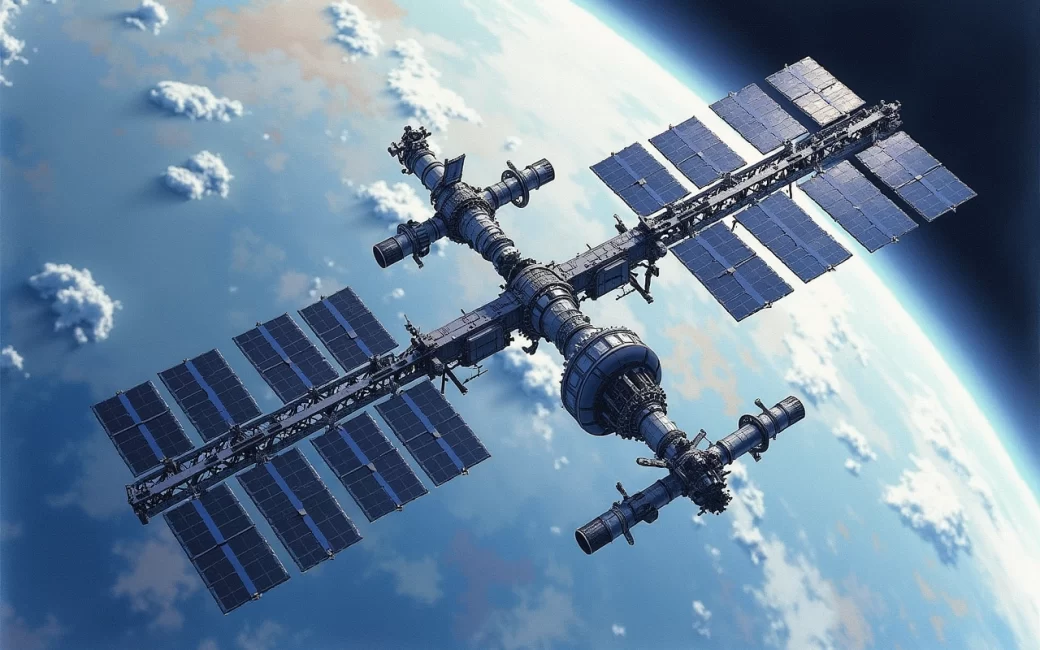
Station orbits in low Earth orbit at about 400 km
The International Space Station circles Earth at roughly 400 kilometres altitude, a zone officially called low Earth orbit, completing one lap in about 90 minutes — which works out to roughly 16 sunrises and sunsets every 24 hours for the crew inside, even though the station itself runs its schedule on Coordinated Universal Time (UTC) rather than local sunrise and sunset. That orbital speed, close to 28,000 km/h, is fast enough that clocks aboard the station run a tiny fraction of a second slower than clocks on the ground over a given period, a relativistic effect so small it has no practical bearing on crew schedules or communications and is really only interesting as physics trivia rather than a planning concern.
The orbit is not stable on its own. Residual molecules from the upper atmosphere still reach 400 km, and drag from that thin gas slowly pulls the station lower over time. Left uncorrected, that decay would eventually bring the station down, so flight controllers periodically fire thrusters — either the station's own engines or those on a docked cargo or crew vehicle — to reboost it back to a workable altitude. This reboost cycle is routine and continuous, and it is the main reason the ISS depends on a steady stream of cargo and crew traffic rather than sitting untouched in orbit for years at a stretch.
That dependence also has an end point. NASA has committed to operating the station through 2030, after which it will be deliberately deorbited using a dedicated vehicle rather than left to decay naturally, a plan that distinguishes the station's finite operating life from the popular idea that a spacecraft in orbit simply stays there indefinitely.
Hardware outside the pressurised modules degrades and gets fixed by spacewalk
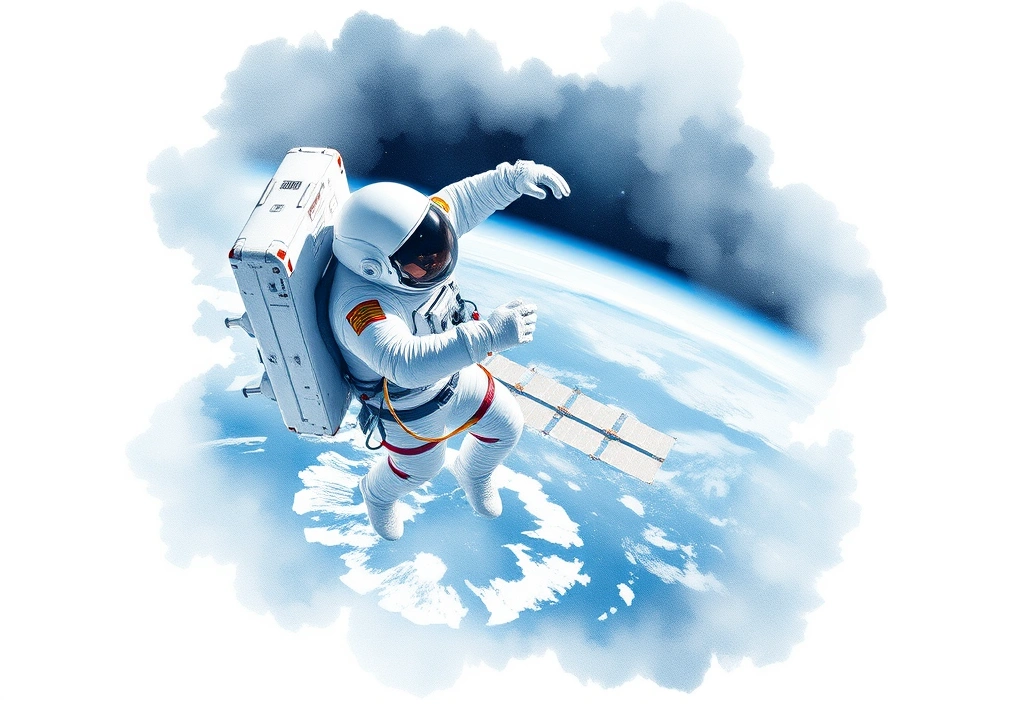
External hardware fails, and when it does, astronauts go outside to fix it because the components in question — solar arrays, truss-mounted radiators, external experiment packages, cameras and antennas — sit beyond the reach of anyone working inside the pressurised modules. Exposure to atomic oxygen, micrometeoroid impacts, thermal cycling between sunlight and shadow, and simple mechanical wear all take a toll on equipment that was never designed to be replaced from indoors.
The sequence generally runs the same way. Station systems monitoring, backed up by flight controllers on the ground, first flags a drop in performance — a solar array producing less power than expected, a pump losing pressure, a joint that stops tracking the sun properly. Engineers diagnose the fault and decide whether it needs a spacewalk, formally called an EVA (extravehicular activity). Two crew members then suit up, cycle through an airlock, and carry out the repair or replacement using tools and spare parts stowed for exactly that purpose, restoring the station's power or cooling capacity once the new component is installed and tested.
Spacewalks are inherently tethered operations: astronauts working outside the station are secured by safety tethers or, in rare cases, by a self-contained jetpack unit designed to fly them back if a tether were ever lost. No astronaut has been lost or left drifting away from the station during an EVA — that scenario, occasionally circulated as a dramatic claim, does not match how spacewalks are actually equipped and conducted. The genuine hazards spacewalkers have faced, such as a helmet developing a water leak, have ended with the crew member brought safely back inside, not lost to space.
Why the station is visible from the ground — and only near dawn or dusk
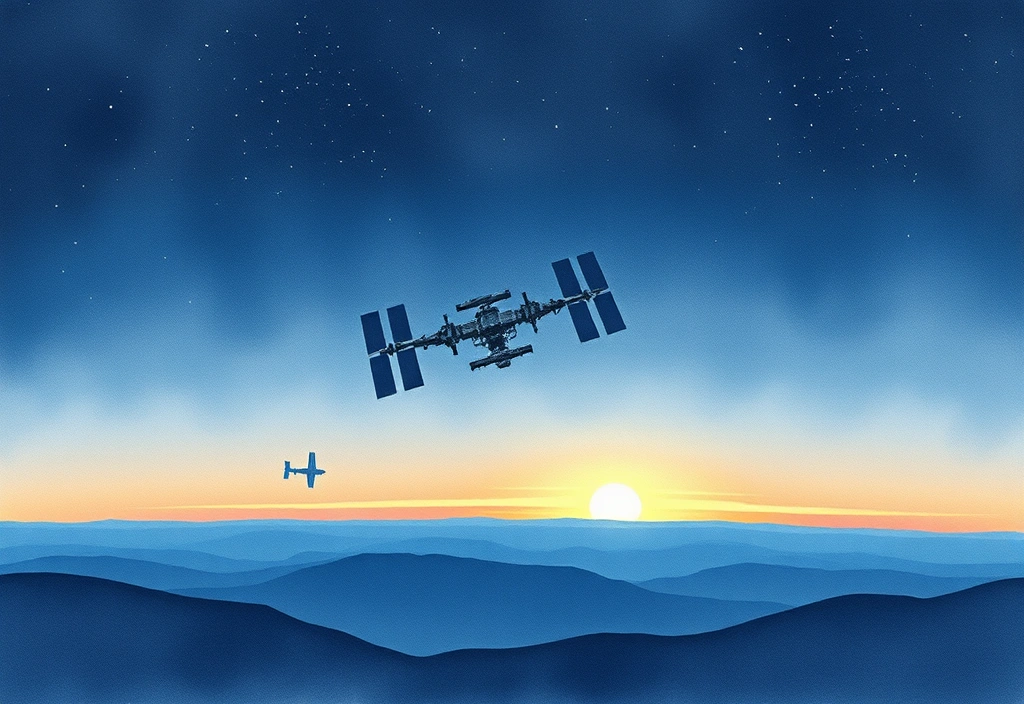
The ISS is bright enough to see with the naked eye because its solar arrays are large, flat and highly reflective, and because the station orbits close enough to Earth that a fast-moving, sunlit point of light is easy to pick out against a darker sky. It looks like an unusually fast, steady-moving star, brighter than almost anything else in the sky except the Moon and Venus, and it takes only a few minutes to cross from horizon to horizon.
Visibility depends on geometry, though, which is why sightings cluster around dawn and dusk rather than the middle of the night. To be seen, the station has to be sunlit while the observer's sky is dark — a condition satisfied only when the sun is below the observer's horizon but the station, higher up, is still catching direct sunlight. At true midnight, the station is usually deep in Earth's shadow and simply isn't lit, so it disappears from view no matter how clear the sky is; near local sunrise or sunset, the geometry lines up and a pass becomes visible.
The most reliable way to find the exact time is to look up a sighting prediction rather than guess. NASA's Spot The Station tool takes a location and returns the date, start time, direction, maximum elevation and duration of each visible pass for that specific spot. No telescope or binoculars are needed — an observer just needs the predicted time, a clear view of the sky in the given direction, and a few minutes of patience to watch a bright point track steadily across the stars.
Free-fall in orbit creates a microgravity laboratory
The reason the ISS exists at all is to give researchers a sustained microgravity environment — not "zero gravity," since gravity at that altitude is nearly as strong as at Earth's surface, but a continuous state of free-fall in which the station and everything inside it, including the crew, fall around Earth together and experience apparent weightlessness. That condition, held for months at a time rather than the seconds available in a drop tower or the minutes available on a parabolic flight, is what makes the station useful as a laboratory.
Experiments that depend on that sustained free-fall are hosted in the station's pressurised modules: crystal growth that forms differently without gravity-driven convection, combustion studies that behave differently without buoyancy, fluid physics, and human physiology research tracking how bone density, muscle mass and the cardiovascular system respond to extended weightlessness. NASA and its partner agencies run this research programme continuously, treating the station less as a single mission and more as a standing facility.
Crew members on multi-month expeditions operate this hardware directly — setting up samples, monitoring runs, swapping components — and much of the resulting material, along with data and hardware that needs to come home rather than be transmitted, returns to Earth aboard cargo vehicles that dock or berth with the station on a rotating schedule.
Space Shuttle
The Space Shuttle, retired from service, delivered most of the station's modules and truss segments during the assembly campaign, using its cargo bay to carry pressurised laboratories and structural elements into orbit and its robotic arm to help install them. Because the shuttle itself could not dock automatically in the way some cargo vehicles do, most of its deliveries were berthed — grappled by the station's own robotic arm and bolted into place — rather than docked directly, a distinction that also separates it from crew vehicles like Soyuz, which dock using their own propulsion and guidance right up to final contact.
A module's path from ground to a working part of the station generally followed this order:
- The module launched inside a Space Shuttle cargo bay or, for later components, atop an expendable rocket.
- The carrying vehicle rendezvoused with the station, matching its orbit and closing distance over several orbits.
- The station's robotic arm, or in some cases the vehicle's own docking system, either berthed or docked the module to an open port.
- Ground controllers and the crew verified a secure mechanical and electrical connection.
- The hatch between the module and the existing station was opened, the module was pressurised and leak-checked, and it became a usable part of the interior.
That sequence, repeated across dozens of shuttle flights along with Russian, European and Japanese launches, is how a station built from separate pieces became one continuously habitable structure. The Smithsonian National Air and Space Museum traces this assembly-by-piece approach as a defining feature of the ISS compared with earlier single-launch space stations such as Skylab or Mir.
International Space Station (ISS)
The ISS is a modular research laboratory in low Earth orbit, built and operated jointly by multiple international space agencies, with the station physically divided into a Russian Orbital Segment and a US Orbital Segment that reflects who built and who primarily operates each set of modules. Day-to-day responsibilities split along similar lines: the Russian segment handles propulsion and reboost using its own modules, while NASA and its partners manage most of the US-built life support, power and research infrastructure, with mission control centres in Houston and Moscow coordinating operations jointly.
According to Wikipedia's overview of the station, assembly began in 1998 and has continued adding, replacing and retiring hardware ever since, making the ISS less a single fixed spacecraft and more a structure that has been continuously modified for decades. The station's scale — multiple connected pressurised modules plus an external truss carrying solar arrays and equipment — is part of what makes it, according to NASA, the largest human-made structure ever assembled in space.
Truss and solar arrays
The truss is the station's external backbone — a long sequence of connected segments running perpendicular to the pressurised modules — and it exists mainly to carry the solar arrays that generate the station's electrical power, along with radiators, cameras and other equipment that doesn't need to be inside a pressurised shell. The arrays rotate to track the sun as the station orbits, and the truss keeps them positioned and thermally managed without interfering with the modules where the crew lives and works.
Because the truss and arrays sit entirely outside, they are also the hardware most exposed to the wear described earlier — impacts, thermal cycling and gradual degradation — which is why so much spacewalk work over the station's life has focused on truss-mounted equipment rather than the interior.
Life support and station systems
Life support is the set of systems that keeps the station's interior habitable: environmental control that manages oxygen, carbon dioxide removal and humidity; thermal control that moves heat from the electronics and the crew out to the external radiators; and power distribution that routes electricity from the solar arrays to everything that needs it. These systems run continuously, without the option of shutting down for maintenance, because the crew depends on them for survival rather than convenience.
Redundancy is built into most of these systems for exactly that reason — critical functions like oxygen generation and carbon dioxide scrubbing typically have backup hardware or backup procedures so a single failure doesn't threaten the crew, and failures that do occur are usually handled the same way external hardware failures are: detected by monitoring, diagnosed by engineers, and repaired or worked around by the crew using onboard spares.
Crew (astronauts and cosmonauts)
The station's crew rotates on a schedule set by the partner agencies, typically arriving and departing a few at a time so the station is rarely left unoccupied. Crew size and duration are planned around each partner's contribution to launches and cargo, which is also part of why participation in the programme is politically bounded rather than open to any interested nation.
China is the notable case: it does not participate in the ISS programme, a restriction that traces to US legislation restricting NASA's bilateral cooperation with Chinese government entities, rather than to any technical barrier. China has instead built and operates its own Tiangong space station independently. The BBC's overview of the ISS at 25 years sets this exclusion against the wider roster of participating and non-participating countries as the station's operating life stretches toward its planned end.
Expedition
An Expedition is the station's unit of long-duration crew residency — a numbered increment, typically running several months, that begins when a crew's predecessors depart and ends when the next handover happens. Expeditions are numbered sequentially and each one is treated as a discrete increment for planning research, spacewalks and cargo deliveries, even though the station itself runs continuously across the boundary between one expedition and the next.
This numbering is mostly an administrative and planning convenience — a way to track who was aboard and what got done during a given stretch — rather than a marker of any change in the station's hardware or orbit, which continue whether or not an expedition handover has just taken place.
When can I see the ISS at my location?
The exact date and time depend entirely on your location and the station's current orbit, so the only reliable answer comes from a location-specific prediction rather than a general rule. NASA's Spot The Station tool generates that prediction directly: enter a city or coordinates and it returns upcoming visible passes, each with a start time, direction, peak elevation and duration.
A few things make a predicted pass easier to actually see:
- Clear skies with minimal cloud cover in the direction the pass is predicted
- As little light pollution as possible, though the station is bright enough to be seen even from many cities
- Checking the prediction close to the pass date, since orbital reboosts and drag mean sightings shift over time and older predictions go stale
- Looking in the correct direction at the correct time — passes move fast and only last a few minutes end to end
Because passes depend on the geometry described earlier — sunlight reaching the station while the ground is dark — a given location often has a run of visible passes for a week or two, followed by a stretch of days with no visible passes at all, simply because the sun-station-observer geometry temporarily stops lining up.
How long can a person stay on the ISS?
A typical long-duration stay runs around six months, matching the length of a standard Expedition rotation, though the station has also hosted stays considerably longer than that as part of research into the physiological effects of extended spaceflight. Longer missions exist specifically to study how the body adapts — and how it recovers afterward — over durations closer to what a mission to Mars might eventually require.
The limiting factors are less about the station's hardware and more about human physiology and mission planning: bone density loss, muscle atrophy, radiation exposure and the psychological demands of prolonged isolation all accumulate with time in orbit, and mission planners weigh those effects against the scientific value of a longer stay. The Planetary Society's overview of the ISS frames the station's continuous crewed presence — unbroken since the first long-duration crew arrived — as itself one of the enduring facts of the programme, distinct from any single astronaut's individual stay length.
For a reader planning to actually see the station rather than just read about it, the next step is concrete: pull up Spot The Station for a specific address, note the next predicted pass, and go outside a few minutes early to find a clear patch of sky in the given direction.