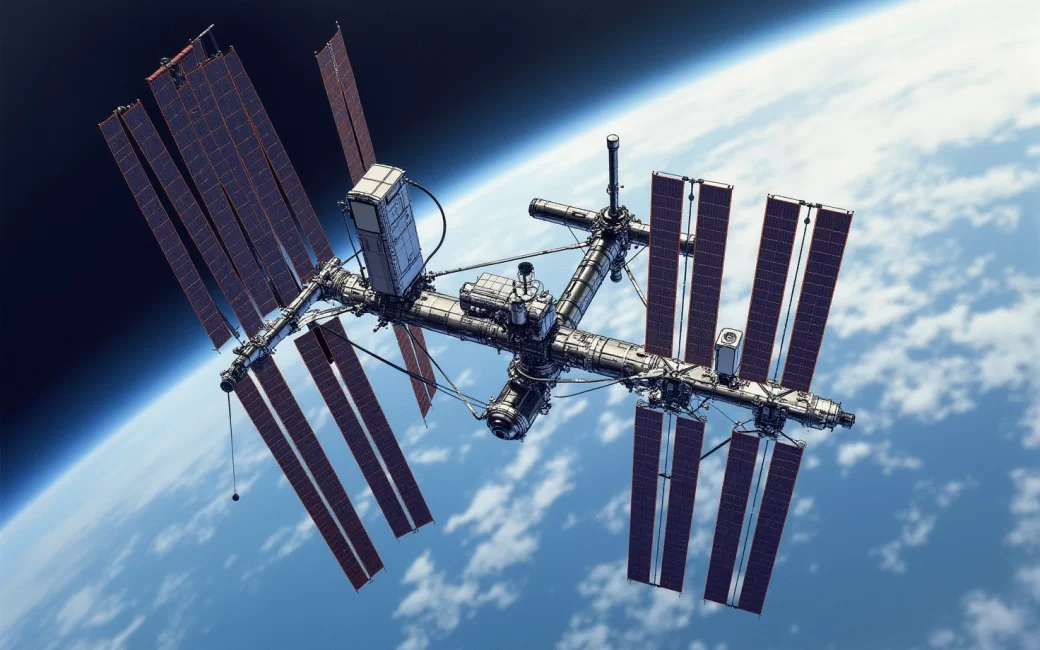
Station orbits in low Earth orbit at about 400 km
The International Space Station circles Earth at an altitude of roughly 400 km, a region known as low Earth orbit, completing one lap of the planet in about 90 minutes according to NASA's station facts and figures page. At that altitude there is still enough residual atmosphere to create drag on the station's large surface area, and that drag slowly bleeds off orbital energy, pulling the station toward a lower altitude over time.
Left uncorrected, that decay would eventually bring the station too low to sustain a stable orbit. Instead, altitude is restored through periodic reboosts — engine burns performed by the station's own thrusters or by the engines of a docked visiting spacecraft, which push the complex back up to its working altitude. This is a routine, scheduled part of operating the station rather than an emergency measure, and it is one reason resupply and crew vehicles need propulsion capability built in, not just cargo space.
That constant balancing act — drag pulling the orbit down, reboosts pushing it back up — is also why the station cannot simply be left alone indefinitely. Every visiting spacecraft that arrives with fuel, water, food and spare parts is also, in effect, keeping the orbit itself alive. When reboosts and resupply eventually stop, the same drag that has to be fought off every few weeks becomes the mechanism that ends the station's flight, which is the subject of the deorbit question addressed further down this article.
Outside hardware fails and spacewalks fix it
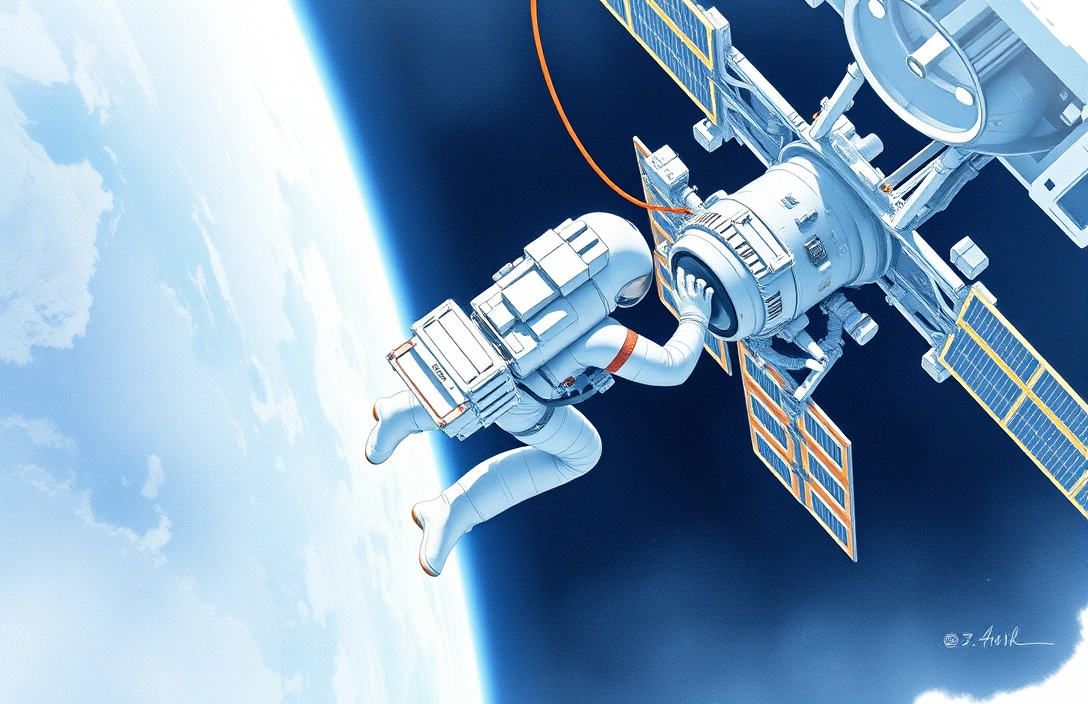
Components mounted outside the pressurised modules — solar array joints, radiators, cameras, external experiment pallets, cooling pumps — are exposed to atomic oxygen, thermal cycling and micrometeoroid impacts, and they degrade or fail the way any exposed hardware does. Ground controllers monitoring telemetry, or the crew inside the modules, are usually the first to notice a fault: a power channel underperforming, a cooling loop losing pressure, a joint that stops tracking the sun properly.
Once a fault is confirmed, the fix generally follows the same order:
- Ground teams diagnose which line-replaceable unit has failed and confirm a spare exists on board or is manifested on an upcoming cargo flight.
- A spacewalk, formally an extravehicular activity or EVA, is scheduled and choreographed in advance using procedures rehearsed on the ground.
- Two crew members exit through an airlock in suits that supply their own oxygen, power and cooling, and translate along handrails to the worksite.
- The failed unit is unbolted, the replacement is installed and its connections checked from inside before the crew re-enters.
- Ground control restores power or cooling to the repaired channel and confirms nominal performance before closing out the task.
Spacewalks are therefore not routine sightseeing outside the station — they happen because a specific piece of externally mounted equipment has stopped doing its job and the station's power or thermal margins depend on getting it working again.
Why the station is visible from Earth after sunset and before sunrise

The station's solar arrays are large, flat and highly reflective, and combined with an orbit only a few hundred kilometres up, sunlight bouncing off them can outshine every star in the sky for the few minutes a pass lasts. It is visible to the naked eye with no telescope or binoculars required, appearing as a fast, steady, non-blinking point of light crossing the sky in a matter of minutes.
Visibility depends on geometry, not just altitude. An observer on the ground needs to be in darkness while the station, much higher up, is still catching direct sunlight — a condition that only exists in the hour or so after sunset and before sunrise, which is why the station is never seen crossing the sky at true midnight from most locations: at that hour Earth's shadow (the umbra) extends far enough up that the station itself has gone dark too.
To see a specific pass, NASA's Spot the Station tool provides a location-specific prediction of time, direction, maximum elevation and duration for the next visible flyover. The practical routine is simple:
- Enter a location on Spot the Station and note the next predicted pass time and compass direction.
- Go outside a few minutes early, away from direct streetlights if possible.
- Look toward the direction given and track a steady point of light moving noticeably faster than an aircraft, with no flashing strobe.
- Expect the pass to last only a few minutes before the station either sets on the horizon or fades into Earth's shadow.
What microgravity research inside the modules actually studies
Free-fall in orbit produces a sustained microgravity environment, and that condition — not the view — is the station's actual scientific purpose. In continuous free-fall, fluids stop settling by density, flames burn differently, and cells and materials grow without the mechanical stress gravity normally imposes, letting researchers isolate variables that are impossible to separate from gravity's effects on Earth.
Experiments hosted inside the pressurised modules exploit that condition directly: crystal growth studies that need a fluid to stay undisturbed, combustion research that behaves nothing like a flame on Earth, and biological work on how cells, tissue and fluid distribution in the body respond when weight is removed. Crew members on multi-month expeditions operate this hardware, exchange samples and hardware modules as new experiments arrive, and return the results to Earth aboard cargo vehicles that undock and re-enter with sample containers packed for the trip home. The modules themselves function as a standing laboratory building, reconfigured experiment by experiment rather than replaced.
The station's modules: how they got there and who runs what
The International Space Station is a modular, crewed research complex assembled in orbit from pressurised laboratory and habitation modules together with unpressurised truss segments, built and operated jointly by NASA, Roscosmos, ESA, JAXA and the Canadian Space Agency. No single agency owns the whole structure; instead the station is broadly divided into a US Orbital Segment and a Russian Orbital Segment, each built from modules contributed by that partnership and each responsible for its own systems, though life support, power and attitude control are shared and interdependent across the whole complex.
Most of the US-segment modules and the station's truss backbone were carried to orbit by the Space Shuttle, whose payload bay and robotic arm made it the only vehicle capable of lifting the station's largest, heaviest structural pieces during the main assembly years; the shuttle fleet's retirement marked the end of that phase of construction and shifted crew and cargo transport onto smaller vehicles. Russian-segment modules, by contrast, launched on Proton rockets and flew to the station under their own propulsion before docking automatically.
Getting any module from launch to a working part of the station follows a broadly consistent sequence:
- The module launches, either in a Shuttle payload bay or on top of its own rocket, sealed and unpressurised for the ride.
- It approaches the station under automated guidance or is grappled by a robotic arm.
- It either docks — flying itself into a port and latching under its own control — or is berthed, where a robotic arm holds it in place against a port for bolts to be driven, a distinction that matters because docking vehicles can typically depart on their own power while berthed cargo craft generally need the arm to release them again.
- Hatches are aligned, pressure is equalised, and the crew opens the hatch between the new module and the rest of the station.
- Crew members outfit the interior — racks, cabling, life support connections — before the module is brought into full operational use.
Truss and solar arrays: the station's power backbone
The station's truss is the long, unpressurised structural spine that runs perpendicular to the modules, and it carries the large solar array wings that generate the station's electrical power along with the radiators that reject waste heat into space. Nothing about the truss is pressurised or habitable; its job is purely structural and electrical, distributing power collected at the array ends to the modules where crew and experiments actually use it.
Because the arrays are gimballed to track the sun as the station orbits, the joints that rotate them are among the most mechanically active parts of the outside structure, and it is failures in these joints, or in the array segments themselves, that most often trigger the spacewalk repair sequence described earlier. The truss also carries external experiment platforms and the mobile transporter that lets the station's robotic arm travel along its length to reach different worksites, making it as much a working platform as a support beam.
Life support and station systems
Environmental control and life support keeps the interior habitable by managing air pressure, oxygen generation, carbon dioxide removal, temperature and humidity, alongside separate systems that manage electrical power and thermal control across the whole structure. These systems run continuously and are shared, to varying degrees, between the US and Russian segments, so that a fault in one system's capacity on one segment can be offset by capacity on the other — one of the practical reasons the station operates as a single integrated vehicle rather than as independent modules.
Redundancy is built in deliberately: oxygen can be generated electrolytically from water or released from stored reserves, and carbon dioxide scrubbing uses more than one type of hardware across the two segments, so that a single equipment failure does not immediately threaten breathable air. Power generated at the solar arrays is stored in batteries for the roughly half of every 90-minute orbit that the station spends in Earth's shadow, then drawn down and recharged again each time the station re-emerges into sunlight — a cycle that repeats roughly sixteen times a day.
Crew, expeditions and who operates the station
Astronauts and cosmonauts live aboard the station in rotating shifts, typically arriving and departing a few at a time so that the complex is never left unstaffed, and their tenure is organised into numbered Expeditions, each a long-duration increment usually lasting several months before the crew handing over duties returns to Earth. An Expedition's numbering runs continuously across a crew's stay regardless of how many individual launches deliver or return its members, which is why mission logs reference an expedition number rather than a single flight.
Day-to-day operation splits along the same partner lines as station construction: NASA and its partner agencies staff and run the US segment's science and systems, while Roscosmos crews and operates the Russian segment, with mission control centres in both Houston and Moscow coordinating jointly rather than one agency directing the other's hardware. Visiting crew and cargo vehicles — currently including US commercial crew and cargo spacecraft alongside Russian Soyuz and Progress vehicles — dock or berth depending on which port and which vehicle design is involved, following the same process described in the assembly sequence above.
How long is 1 hour in ISS?
An hour on the station passes at the same rate a clock on the ground measures it — the station keeps time on Coordinated Universal Time (UTC), the same reference used worldwide, not a locally invented "station time." What differs is how much of the sky an hour covers: because the station completes an orbit in roughly 90 minutes, a single hour is enough for the crew to see a large fraction of one full lap of Earth, and across a full day the station experiences about sixteen sunrises and sixteen sunsets rather than one, a figure NASA cites directly in its station facts and figures summary.
There is a genuine, if vanishingly small, relativistic effect at play too. Moving at orbital velocity causes clocks on the station to run very slightly slower than clocks on the ground, an effect too small to notice in daily operations and irrelevant to scheduling, but real and measurable over the course of long-duration missions. For any practical purpose — meal times, sleep schedules, handover briefings — an hour aboard the station is an hour, tracked on UTC exactly as it would be in any control room on the ground.
How much does it cost to go to the International Space Station?
There is no single number, because "cost to go" means different things depending on who is flying and why. A government astronaut's seat, a private astronaut's ticket, and a kilogram of cargo delivered to the station are three separate line items priced by different mechanisms and different customers.
| Type of trip | Who buys it | What determines the price |
|---|---|---|
| Government astronaut seat | NASA, on behalf of a partner agency's crew member | Negotiated per-seat contract price under NASA's commercial crew program |
| Private astronaut mission | A private individual or company-sponsored crew member | Mission-specific pricing covering transport, station accommodation and support |
| Cargo delivery | NASA or partner agencies resupplying the station | Contracted price per cargo mission, converted to a cost per kilogram delivered |
None of these figures is fixed for the life of the program — commercial crew seat prices and cargo contract values are negotiated and updated over time, and private astronaut mission pricing varies by operator and mission scope, so a specific dollar figure quoted today should be checked against the current contract rather than treated as permanent. What stays constant is the split itself: a government seat, a private mission and a cargo kilogram are priced through entirely different mechanisms, and conflating them is the most common way a single "cost to reach the ISS" number ends up misleading.
How many years does the ISS have left?
The station currently operates under an extension that keeps it flying to the end of the decade, with NASA and its international partners having committed to continued operations before a planned, deliberate deorbit rather than an open-ended retirement date, as described in NASA's overview of the station program. Deorbit itself is a controlled operation, not an accident: it involves a series of engine burns, most likely using a dedicated deorbit vehicle developed for the purpose, that lower the station's orbit in a targeted way so that the structure re-enters over an uninhabited stretch of ocean rather than breaking up unpredictably over land.
What replaces the station is still taking shape rather than settled. NASA's stated plan is to transition low Earth orbit research and crew activity to commercially owned and operated space stations once those platforms are ready, so the station's retirement is tied less to a fixed calendar year and more to when its systems reach the end of their certified life and when commercial successors are operational, a timeline covered in more detail in Wikipedia's overview of the station's program history. Until that handover happens, the station keeps flying on the reboost-and-resupply cycle described at the start of this article — the same drag that has to be corrected every few weeks is what eventually brings it down for good.
What is the most terrifying space photo?
"Terrifying" is a description of a viewer's reaction, not a technical property of an image, so no single photograph holds that title in any documented sense — what does exist are specific images that recur in public discussion because of what they show, not because any agency or publication has ranked them as frightening. Photographs taken from the station of large storm systems, wildfires or auroras from orbit are commonly shared and described in dramatic terms in general coverage, including retrospective pieces marking station anniversaries such as the BBC's roundup of station imagery and statistics.
What can be checked about any specific viral station photograph is the instrument, the wavelength and the scale: whether it came from a handheld crew camera through a window, an external station camera, or a separate Earth-observing satellite; whether colours are true-colour or a false-colour rendering of infrared or other non-visible data; and what area of ground or atmosphere the frame actually covers. Those details, not a subjective label, are what determine whether an image is showing something genuinely unusual or a normal phenomenon photographed at a dramatic moment.
For a specific image circulating online, check its caption against the mission and instrument that produced it, and treat "terrifying" or "eerie" as marketing language rather than a description worth repeating.